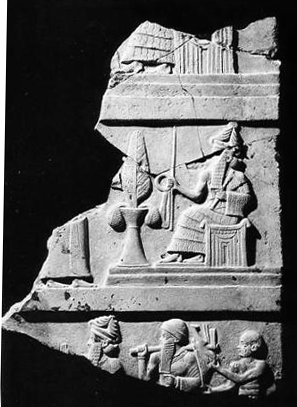
" . . . . South of the dark forests of northern Russia open vast steppe lands, stretching from eastern Europe to Mongolia. Constantly varying in climate, punctuated by giant mountain chains, these steppes may support settled farming or pasturage, or--particularly towards China--degenerate into desert. North of Tibet a complex series of mountain ranges divides the steppes. Westwards lies the broad area inhabited predominantly by white races since time immemorial; to the east, the home terrain of the mongoloids, although each group interpenetrated the other. Southwards again an immense mountain zone shuts off the steppe lands from warmer climes: dividing Greece, ringing Anatolia, surrounding the great, dusty plateau of Iran as the Zagros, Elburz and other ranges, marching further east as the Hindu Kush of Afghanistan and the Himalayas of India, it severely inhibited the passage of commerce and invasion. Great rivers run down from its heights: the flat, alluvial plains of the lower Tigris and Euphrates hold the Syrian desert at bay, the Oxus and Jaxartes meander through central Asia and into the Aral Sea, while the Indus and Ganges water the Indian north . . . . " - [Colledge, Malcolm A. R., Parthian Art Ithaca, NY: Cornell University Press. 1977.]
Manual of Oriental Antiquities, including the Architecture, Sculpture, and Industrial Arts of Chaldæ, Assyria, Persia, Syria, Judæ, Phœnician, and Carthage. Ernest Babelon, Librarian of the Department of Medals and Antiques in the Bibliothèque Nationale, Paris. London: H. Grevel and Co. 1906.
- Chaldæn - "The extensive region of Western Asia to which the Greeks gave the name of Mesopotamia was already, at the period which lies farthest back among the memories of mankind, the centre of a mighty civilization . . . . "
- Assyrian - "Besides these sanctuaries erected on the top of staged towers, in which the priests passed the night in watching the courses of the stars, there were other temples . . . . "
- Elamite [Discoveries at Suza] - "The ruins of Susa, situated at the north of Ahwaz, form a number of immense tells which cover an extent of four and a half to six square miles on both banks of the river Kerkha . . . "
- Hittites - "The name of Hittites [Khatti, Kheta] appears simultaneously in the Bible, the hieroglyphic documents, and the cuneiform texts. It is given to populations of different origin who inhabited Syria from the Euphrates to the borders of Egypt, and also Cappadocia and the greater part of Asia Minor from the mountains of Armenia to the banks of the Halys and the Hermus . . . . "
- Phœnician & Cypriot - "The Phœnicians, established on the coast of northern Syria, were not simply the agents of commerce; they also carried the art of the great Asiatic civilizations to all the coasts upon which they set up their factories, and among all the races with whom they formed relations of business . . . . "
The Art of Ancient Iran, Pre-Islamic Cultures. Porada, Edith [With the collaboration of R. H. Dyson and contributions by C.K. Wilkinson]. New York: Crown Publishers, Inc. Art of the World. 1962. [Akkadians, Elamites, Manneans, Medes, Achaemenids, Seleucids, Parthians, Sasanian]
- The Art of the Achaemenids
- The Art of the Akkad and Post-Akkad
- The Art of the Elamites
- The Bronzes of Luristan
- The Finds of Hasanlu / The Art of the Manneans
- The Art of the Medes
- The Art of the Parthians
- .Finds of The Late Second and Early First Millennium B.C. at Sialk Near Kashan
- Sasanian Art
- The Art of The Seleucids
- The Treasure of Ziwiye
The Art of The Middle East, including Persia, Mesopotamia and Palestine. Woolley, Leonard. New York: Crown Publishers. 1961. [Elam, Sumer, Syria & Palestine, Hurri & Hittites, Anatolia.]
- Elam - Before the Coming of the Indo-Europeans
- Sumer - From the Beginnings of Art to The End of The Early Dynastic Period
- Sumer and Akkad - The Sargonid Age and The Third Dynasty of Ur to the Time of Hammurabi
- Syria and Palestine: From the Earliest Times Until The Conquest of Alexander
- The Hurri and The Hittites
- Anatolia, 1200-330 B.C.
Artamonov, M.I. The Splendor of Scythian Art, Treasures from Scythian Tombs, with an introduction by Tamara Talbot Rice. New Ork: Frederick A. Praeger, Publishers. 1969.
Waugh's Central Asia
http://faculty.washington.edu/dwaugh/CA/intropg.html
Central Asia: A Historical Overview (Asia Society)
http://asiasociety.org/central-asia-historical-overview
Center for the Study of Eurasian Nomads
http://www.csen.org
EURASIANET
http://www.eurasianet.org
Asian Studies WWW Virtual Library
http://vlib.org/AsianStudies
Ancient Greek Culture [History, Mythology [Gods, Demi-Gods, Heros], Religous Beliefs, Philosophy, Pottery, Architecture, Painting & Sculpture, Literature, Language, A Glossary, Index of Names, A Bibliography, Links]
Prehistoric Thera: Akrotiri - Excavations at Thera Vi. [1972 Season]. By Spyridon Marinatos, Prof. of Arch., EM., Uiversity of Athens. Athens. 1974. With 6 Figures in the Text, 112 Plates in Black and White, and 11 Colour Plates with 7 Maps in Spearate Pocket. Athens. 1974.
Isthmia. Broneer, Oscar. "Topography and Architecture." Vol II. Isthmia, Excavations by the University of Chicago under the Auspices of The American School of Classical Studies at Athens. Princeton, New Jersey: American School of Classical Studies at Athens. 1973.
Evans, Sir Arthur. The Palace of Minos. A Comparative Account of the Successive Stages of the Early Cretan Civilization as Illustrated by the Discoveries. Vol. II: Part II. Town-Houses in Knossos of the New Era and Restored West Palace Section, with its State Approach. New York: Biblo and Tannen:. 1964.
Hauser, Arnold. "Crete" - in The Social History of Art. Vol. 1. New York: Vintage Books/Random House. 1951.
Doumas, Christos, Prof. of Archaeology at the Univ. of Athens, Director of Excavations at Akrotiri. Santorini, A Guide to the Island and Its Archaeological Treasures. Athens: Ekdotike Athenon S.A. 1995.
Kyriazis, Constantine D. Eternal Greece. Translated by Harry T. Hionides. A Chat Publication.]
Lévêque, Pierre. The Birth of Greece. NY: Harry N. Abrams, Inc./DISCOVERIES. 1994 [Pierre Lévêque is a professor of Greek history at the Université de Franche-ComtÚ, in BesanÙon. In addition to his scholarly histories of Greece, he has published several popular surveys of ancient Greek culture as well as guidebooks to Greece and Sicily. His most recent published works are about the history of religion.]
Minoan Art. Walberg, Gisela. Tradition and Innovation. Essays in Minoan Art. Mainz am Rhein: Verlag Philipp Von Zabern. 1986.
Welch, Stuart Cary. Imperial Mughal Painting. New York: George Braziller. 1978.
De Silva, Anil and photographs by Dominque Darbois. The Art of Chinese Landscape Painting in the Caves of Tun-Huang. New York: Crown Publishers, Inc. 1964.
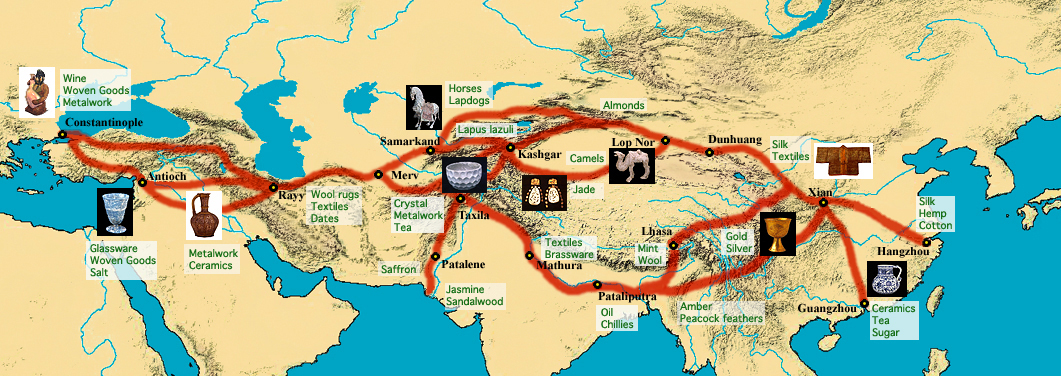
This image comes from Silk Road Trade Routes - The Silk Road Seattle Virtual Art Exhibit [Project Director: Professor Daniel C. Waugh, University of Washington, USA. Design by Lance Jenott.
International Dunhuang Project - "A ground-breaking international collaboration to make more than 100,000 manuscripts, paintings and artefacts from Dunhuang and other Silk Road sites freely available on the internet with top quality colour images. The items are shown in context, with bibliographies, maps, photographs, site plans and other information relating to their provenance, history and present condition, giving the scholar, the student and the layman a unique insight into Silk Road life during the first millennium AD. . . . . The collections consist largely of items, dating from about 100 BC to AD 1200, including paintings, murals, artefacts, coins and manuscripts, the last in over twenty different languages and scripts. The size and scope of the collections, as well as their fragility and limited access, has meant that, while they constitute a primary research resource for the history and literature of the region, many of the manuscripts in particular have yet to be studied in detail. The International Dunhuang Project aims to reunite this material by making it freely available online." [Founder Members: Bibliothèque nationale de France, Paris; The British Library, London; The Institute of Oriental Studies, St. Petersburg ; The National Library of China, Beijing ; The National Museum, New Delhi;
Staatsbibliothek, Berlin
http://idp.bl.uk
Silk Road Seattle - "An ongoing public education project using the "Silk Road" theme to explore cultural interaction across Eurasia from the beginning of the Common Era (A. D.) to the Seventeenth Century."
http://depts.washington.edu/uwch/silkroad/index.shtml
- Including:
Cities and Architecture along the Silk Road
Traditional Cultures in Central Asia - Dwellings, Food, Religion, Animals, Oral Epic
Silk Road Narratives: A Collection of Historical Texts
Art of the Silk Road - [Go to Index at the bottom of the page]
Maps
Lost Cities of the Silk Road
http://www.alumni.caltech.edu/~pamlogan/silkroad/index.html
Other Silk Road Related Sites
http://www.silk-road.com/toc/links.html
Copyright
The contents of this site, including all images and text, are for personal, educational, non-commercial use only. The contents of this site may not be reproduced in any form without proper reference to Text, Author, Publisher, and Date of Publication [and page #s when suitable].